Prefab Cabinets: What the Word Covers
Prefab tells you where a cabinet was built, not how it was built. Every style in CasaBuilt's six-cabinet starter kitchen is factory-made, and the published prices still run from $1,199.50 to $2,295.64 for the same six boxes. The word leaves a larger question open: how much of the cabinet the factory finished before the carton was sealed.
Key takeaways
- Prefab is an umbrella term covering stock, flat-pack RTA, pre-assembled and semi-custom cabinetry.
- The published base range runs from 9 in to 42 in wide, so a standard cabinet still means a choice of 12 widths.
- Four styles of the same starter kitchen span $1,199.50 to $2,295.64, a gap of $1,096.14.
- Flat-pack orders ship in 3-10 business days; pre-assembled is quoted at within two weeks.
One word, five supply models
Prefabricated means built in a factory rather than on site, and almost every cabinet sold in the United States meets that description. The useful distinctions sit underneath it, and they are about labor rather than quality.
Stock cabinets are finished, joined and waiting in a warehouse. The buyer takes the size that exists. That is usually the cheapest route because somebody else guessed the demand and paid to store the guess.
Ready-to-assemble cabinets are cut, drilled and finished at the factory, then shipped flat with a bag of hardware. The box is the same box; the assembly hour moves into the buyer's evening.
Pre-assembled cabinets use those same parts, joined and squared at the factory before packing. The carton is a cube instead of a flat stack, which changes freight and storage but removes the screwdriver work.
Semi-custom keeps the standard box and opens the door, finish and width to a list. Nothing is drawn from scratch, but the run is planned to the inch inside a published range.
Custom starts from a drawing and a tolerance, and the quote reflects the drawing rather than a catalog.
Each model answers a different question about who does the work. None of them answers the question buyers actually care about, which is what the cabinet is made of.
What each label fixes before you order
Read the table as a contract. The middle two columns describe who owns the labor; the last one gives the published figure that separates the rows in CasaBuilt's catalog.
| Term | What the factory finishes | What the buyer still owns | Published figure |
|---|---|---|---|
| Stock | Box, door and finish, joined | The layout, and whatever size happens to exist | Not the model CasaBuilt sells; orders are built to the listed widths |
| Flat-pack RTA | Every panel cut, drilled and finished; hardware bagged | Assembly, squaring, installation | 3-10 business days to dispatch |
| Pre-assembled | Box joined and door hung before packing | Installation only | Within two weeks |
| Semi-custom | Standard box, chosen door and finish | The width choice inside the range | Base widths 9 in to 42 in |
| Custom | Everything, to a drawing | Approval and a measured room | CasaBuilt publishes stock widths, not made-to-drawing sizes |
Two rows in that table describe the same cabinet. A flat-pack box and a pre-assembled box leave the same line with the same panels and the same hinges. The difference is a few hours of assembly and a different shipping shape. That is why the supply model can move the delivery date without touching the specification at all.
Four styles, one starter kitchen
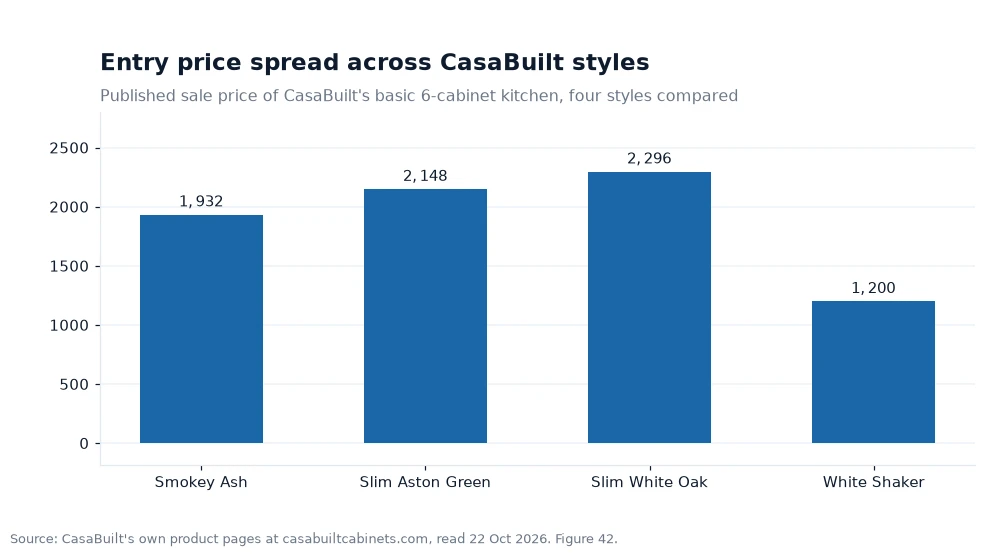
The spread inside a single catalog is wider than most buyers expect. CasaBuilt prices a basic kitchen as two base cabinets, two wall cabinets, one tall cabinet and one vanity, and the same six pieces carry very different totals depending on the door.
White Shaker is listed at $1,199.50 against a $2,399.00 list price. Smokey Ash is $1,932.42 against $2,415.52. Slim Aston Green is $2,148.28 against $2,685.36, and Slim White Oak is $2,295.64 against $2,869.56. All four are sold as prefab cabinets in the ordinary sense of the phrase, and the most expensive is 91% dearer than the cheapest.
The gap is not a markup on one object. White Shaker carries a 50% discount while the Slim lines carry 20%, so the list prices sit closer together than the sale prices suggest. The finish work differs too. The published specification lists seven layers of paint with a UV protective finish, and every extra pass costs labor before the door is ever hung.
A buyer who wants to see that difference before paying for it can order one of the 16 door samples at $9.99, refundable with a cabinet purchase. Two premium samples, Black Quarterline at $19.50 and Beach Impression at $22.00, are priced separately.
What flat-pack adds to the definition
Flat-pack is the model most people mean when they say prefab, and it is the one that changes the buyer's week the most. The carton holds panels, a hardware bag and printed steps. CasaBuilt also publishes assembly videos and offers support by email and phone while the boxes are open on the floor.
The published window is 3-10 business days for RTA orders, with Alaska and Hawaii excluded, and free shipping begins at $2,500. The trade program tightens the window to three business days or less through a quick-ship guarantee. Those figures describe dispatch rather than arrival, so read them as a window and plan the install around the far end.
Assembly is the part nobody prices. A basic kitchen is six cabinets; a full kitchen is closer to twenty, and each one needs squaring before the next is hung. Buyers who would rather not do that work can order the same door pre-assembled, and buyers who want the flat cartons can compare the flat-pack collection against the assembled route before choosing.
The definition matters at the checkout because it decides what arrives and when. A label that promises a factory-built box says nothing about whether the box will need a mallet, a level and a Saturday.
Worked example
The chart lists four entry prices for the same six-cabinet kitchen: White Shaker $1,199.50, Smokey Ash $1,932.42, Slim Aston Green $2,148.28 and Slim White Oak $2,295.64. Subtract the cheapest from each of the others. Smokey Ash is $1,932.42 minus $1,199.50, or $732.92 above White Shaker. Slim Aston Green is $2,148.28 minus $1,199.50, or $948.78 above. Slim White Oak is $2,295.64 minus $1,199.50, or $1,096.14 above.
Divide each total by the six cabinets in the bundle. White Shaker is $199.92 per cabinet, Smokey Ash $322.07, Slim Aston Green $358.05 and Slim White Oak $382.61. The top price divided by the bottom price is $2,295.64 ÷ $1,199.50 = 1.91, so the oak style costs 91% more for the same cabinet count. Spent on samples at $9.99 each, the $1,096.14 gap buys 109 doors with $7.23 left over.
Frequently asked questions
Is a prefab cabinet the same as a stock cabinet?
No. Stock is one supply model under the prefab umbrella. A stock cabinet is already joined and sitting in a warehouse, while a flat-pack cabinet is also factory-made but ships as panels and hardware. The build quality can be identical; the difference is how much assembly happened before the carton closed.
Does flat-pack mean lower quality?
The published specification is the same for both routes: a 1/2-inch birch plywood box, a 3/4-inch by 1-1/2-inch solid birch face frame, soft-close concealed hinges, soft-close undermount glides, 5/8-inch dovetail drawers and 3/4-inch adjustable plywood shelves. Flat-pack changes who turns the screws, not the parts in the box.
How should I compare two prefab quotes?
Compare the same cabinet list, then compare box material, panel thickness, hinge and glide brand range, drawer joint and finish coats. Ask whether the quoted price includes assembly and freight. CasaBuilt publishes a one-year warranty against manufacturing defects, so a quote that implies more coverage than that is worth checking in writing.
Choose the carton before the door
Decide first whether the cabinets will arrive flat or joined, because that choice sets the delivery window, the storage space and the labor. Then pick the door and finish, using samples rather than a screen. Write down the wall lengths and appliance widths before either decision, since a standard width only helps if the run was measured correctly. The label on the carton is the start of the comparison, not the end of it.
Figures quoted here come from the manufacturer's own website, read 22 Oct 2026[1].