What Buyers Should Know About Planning multi-supplier purchasing
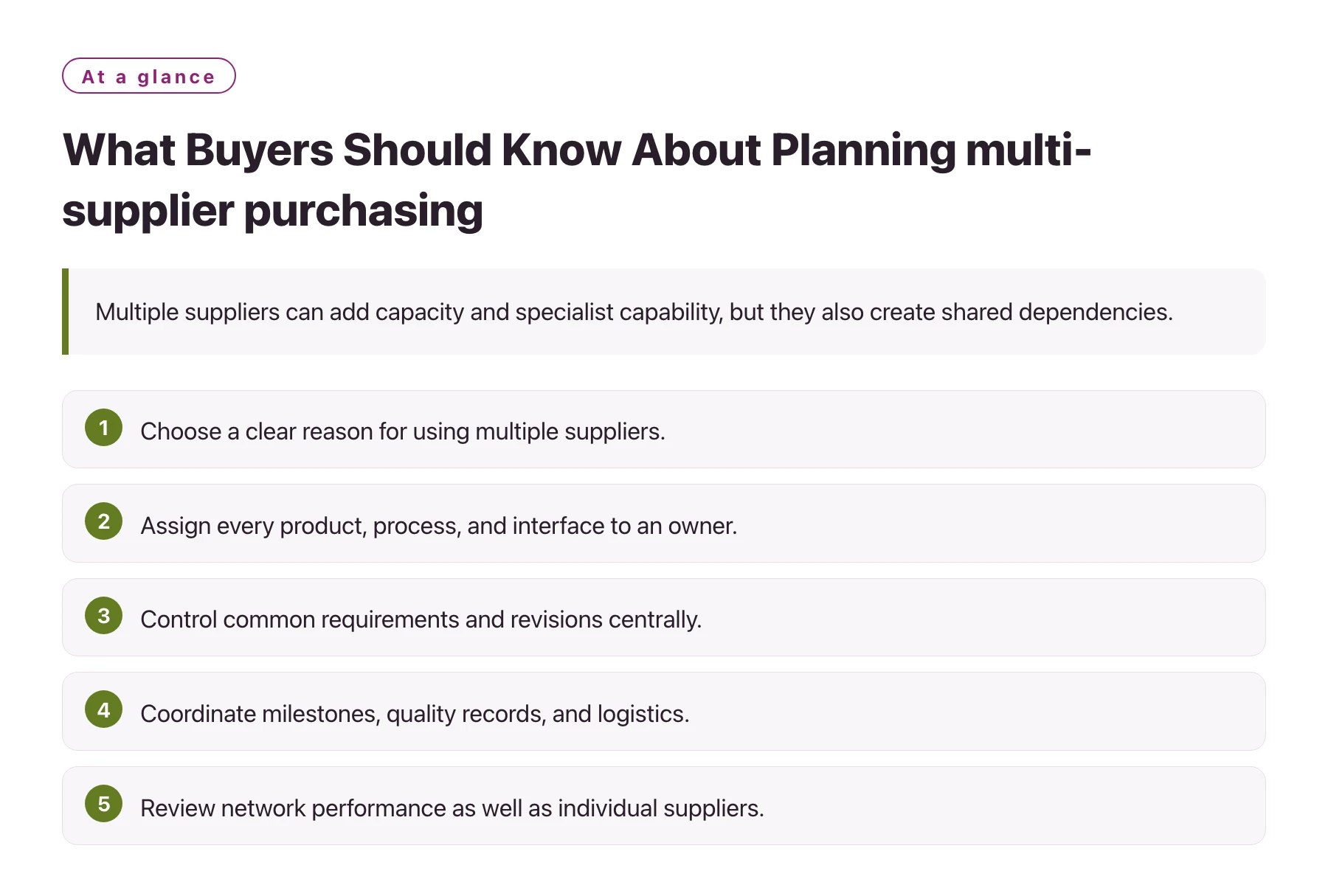
Multiple suppliers can add capacity and specialist capability, but they also create shared dependencies. Define package boundaries, one specification baseline, decision owners, and coordinated milestones before splitting an order.
Key takeaways
- Choose a clear reason for using multiple suppliers.
- Assign every product, process, and interface to an owner.
- Control common requirements and revisions centrally.
- Coordinate milestones, quality records, and logistics.
- Review network performance as well as individual suppliers.
The buyer’s coordination plan connects suppliers that otherwise see only their own package. A shared register helps keep requirements, decisions, and deliveries aligned.
1. Decide why the purchase needs multiple suppliers
Multiple suppliers may increase capacity, provide specialist capability, reduce dependency, or cover different product categories. State the reason before dividing the work. Without a defined objective, parallel sourcing can create extra coordination, inconsistent specifications, and duplicated effort without improving the result.
List the products, volumes, delivery windows, and performance requirements involved. Decide whether suppliers will make the same item, different items in one package, or components that must fit together. Each model creates different requirements for specification control, inspection, shipment sequencing, and responsibility.
2. Divide scope without leaving gaps
Create a scope map by product, component, process, geography, or milestone. For each work package, name one accountable supplier and identify boundaries with adjacent packages. Clarify who provides shared tooling, common packaging, final assembly, consolidated documentation, or system integration.
Use an interface register to record dimensions, materials, connectors, finish, tolerances, drawings, owner, and approval deadline. Ask suppliers to confirm the interface in writing. If no party owns an interface, assign it to the buyer or designate an integrator before quotations are finalized.
3. Establish one master specification baseline
Create a master requirement set and supplier-specific annexes. Give each document a revision and effective date. Identify common requirements and any approved variation. Every supplier should receive the current shared interface information so an update to one package does not leave the others working to an obsolete assumption.
Maintain a change log that lists affected suppliers, downstream dependencies, required response, and buyer approval. A change to a material, dimension, label, or delivery sequence can affect several packages at once. Notify impacted parties together and record acknowledgements before production continues.
4. Build a coordinated sourcing schedule
Map dependencies from specification and supplier discovery through samples, approvals, production, inspection, shipping, receiving, and installation. Identify the critical path and long-lead items. Include time for clarifications and buyer reviews; several suppliers create several parallel approval queues.
Set common milestone definitions and reporting cadence. Ask each supplier for a plan using the same milestone names, quantity basis, and status definitions. Show where one supplier’s delay blocks another’s work, and decide whether buffer stock, alternate sources, or resequencing can reduce the impact.
5. Qualify each supplier and the combined network
The U.S. Department of Commerce recommends due diligence when evaluating foreign business partners. Verify each contracting entity, manufacturing site, contact, payment path, capability claim, and relevant references proportionately. Also assess network dependencies such as common subcontractors, shared raw materials, or one export agent serving several factories. [1]
A set of individually capable suppliers may still be hard to coordinate. Ask who can share production status, preserve common revisions, resolve cross-package conflicts, and provide consistent records. If a sourcing intermediary or lead supplier coordinates the group, define its authority and how information is verified.
6. Compare offers and total programme cost
Normalize each quotation by product configuration, quantity, currency, tooling, samples, quality checks, packing, delivery basis, lead time, and exclusions. Then calculate combined landed cost and the buyer’s coordination effort. Split volumes can change unit prices, minimum orders, freight utilization, and quality-control expense.
Model the cost of consolidation, separate shipments, extra warehousing, partial delivery, and a failed component that delays an entire system. Compare a low-cost split award with a coordinated single-provider option where available. Keep financial estimates and operational risks visible as separate decision inputs.
7. Define communication and shared records
Name a primary contact for every supplier and one buyer-side coordinator who owns the consolidated view. Agree update frequency, response windows, escalation path, working language, and how changes are approved. Ask suppliers to use a common status format with milestone, evidence, blocker, owner, and due date.
Store approved drawings, quotations, sample decisions, inspection results, deviations, and shipment records in a shared controlled location. Limit access to confidential information by package. Keep a decision log that records who approved price, specification, supplier, schedule changes, and final release.
8. Coordinate quality and corrective action
Use common definitions for defect classes, inspection records, sample identification, corrective-action deadlines, and evidence where products must fit or function together. Add package-specific criteria where products differ. Identify who controls incoming inspection and how results are communicated to the responsible factory.
For a cross-supplier defect, determine which party investigates the interface and who owns containment. Preserve lot and revision identity so a component from one supplier can be matched to another supplier’s assembly. Require approval before a rework or substitution changes the agreed baseline.
9. Plan logistics and order release
Decide whether goods ship directly, consolidate at a warehouse, or move through a lead supplier. Confirm delivery terms, named locations, export documents, packing lists, carton identification, booking responsibility, insurance, customs, and receiving appointments for every package.
Define partial shipment rules and whether one missing supplier item blocks the project. Identify which package can be released independently and which must wait for integration, inspection, or documentation. Track shipment identifiers to the master order so quantities and revisions remain visible across separate bookings.
10. Review performance across the full network
Monitor each supplier’s delivery, quality, responsiveness, and evidence, then review system-level outcomes such as compatibility, total lead time, consolidated cost, and room or production readiness. A supplier can meet its own milestone while the programme still fails if its output does not fit the next package.
Buyers working with js-sourcing.com can use a supplier matrix, interface register, and shared milestone plan to coordinate discovery, quotations, and follow-up. Confirm current sourcing scope directly and keep the buyer’s approval authority over supplier awards, changes, and final acceptance.
Sources
Frequently asked questions
When should I use multiple suppliers?
Use them when capability, capacity, resilience, or category specialization justifies the added interface and coordination work.
How do I prevent gaps between supplier packages?
Assign accountable owners, create an interface register, and require written confirmation of shared dimensions, materials, and delivery dependencies.
Who should control specification revisions?
A named buyer-side owner should manage one master baseline and notify every affected supplier of approved changes.
How should I coordinate shipments from several factories?
Choose direct delivery or consolidation, then align package identifiers, documents, bookings, receiving windows, and release conditions.